Thursday, August 18, 2011
Here’s something that seems to have flown under the radar.

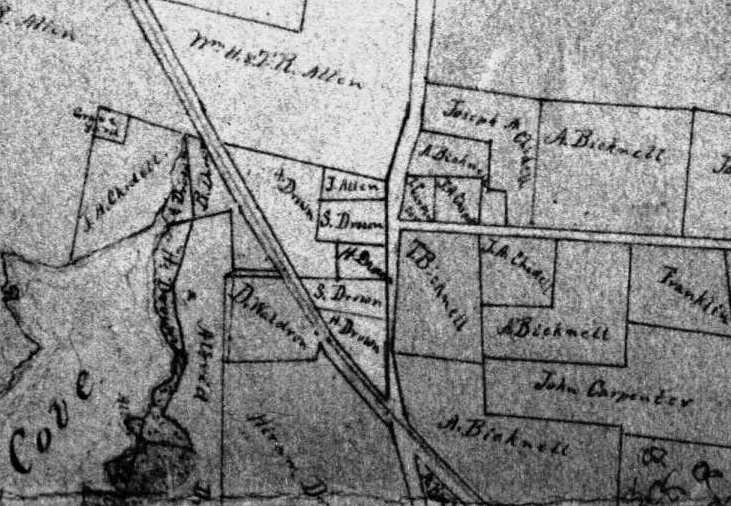
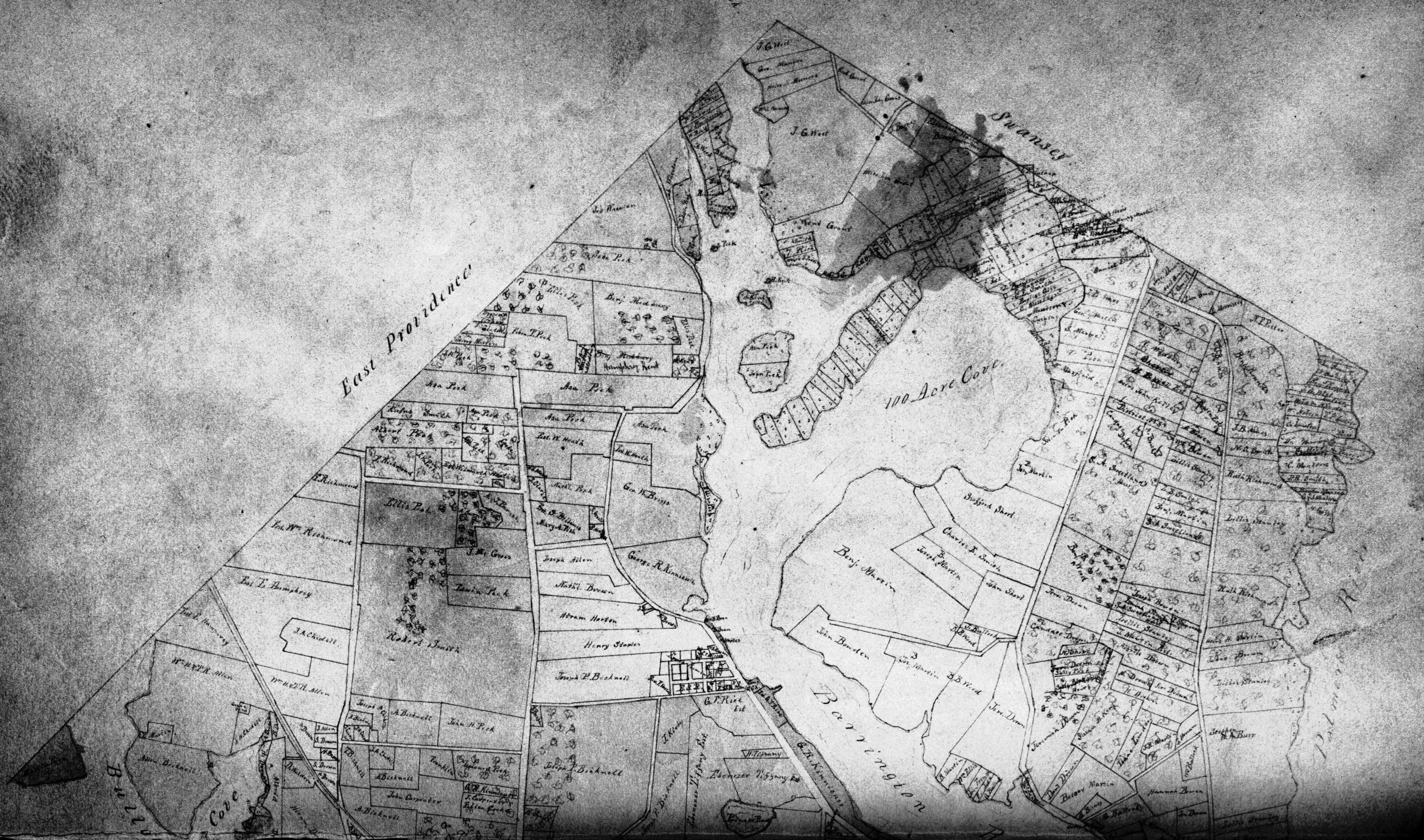
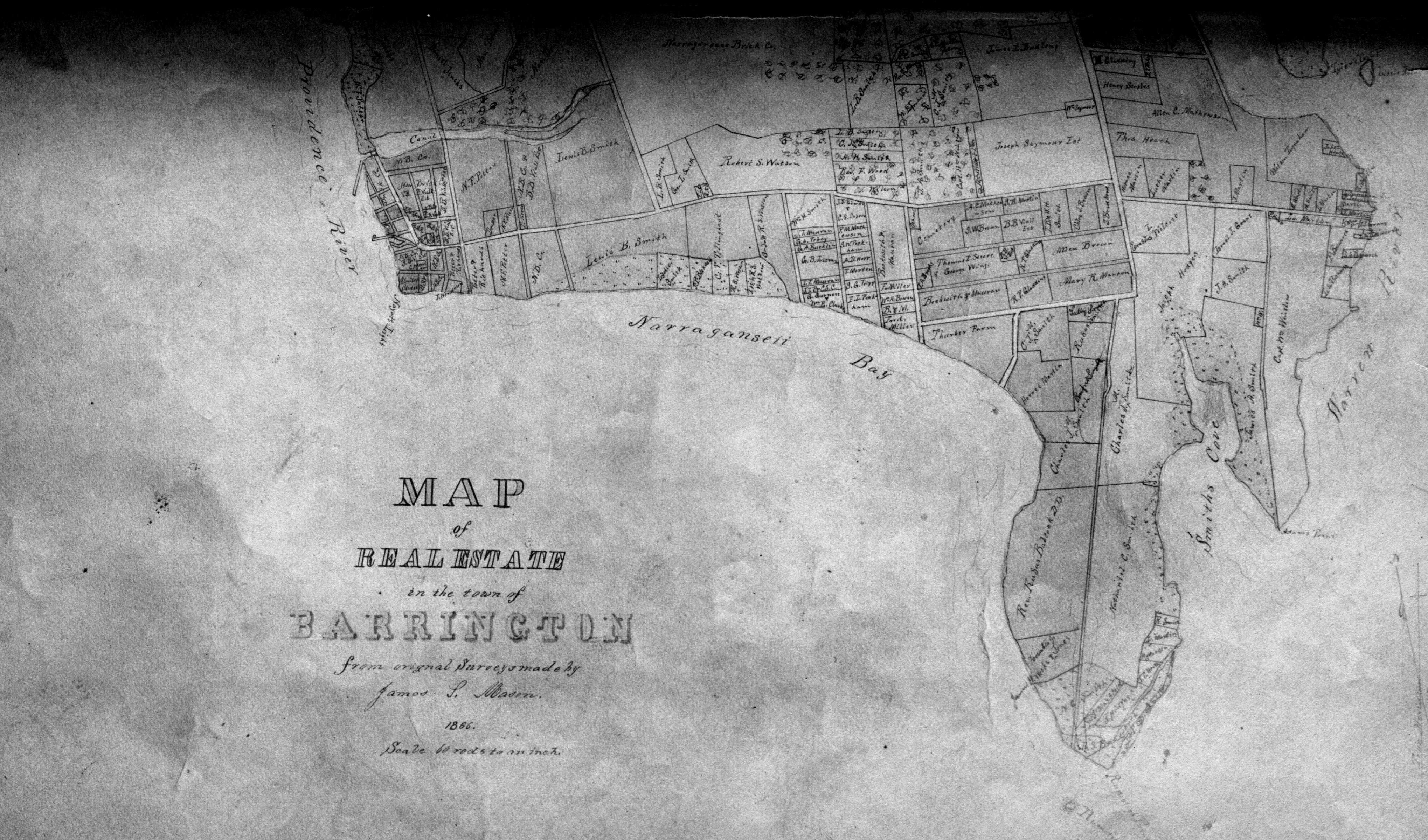
A 1993 book, Historical and Architectural Resources of Barrington, Rhode Island, reproduced two fine old maps, from 1851 and 1870, demonstrating the growth of this town, especially since a railway station was put in at West Barrington in 1868 and development of farmland into bayside summer colonies began. Those maps show the location of houses, but no property parcel divisions, in what was in 1851 still a town of farms. Thumbing in the library through Thomas Bicknell’s Historical Address and Poem and Delivered at the Centennial Celebration of the Incorporation of the Town of Barrington (Providence, 1870) brought me to a map — very faint and faded — that I had not seen before, showing Barrington in 1866, and most importantly, showing parcel lines instead of structures. Turns out the people at the Preservation Society had not been aware of this map either, sitting quietly on the shelves upstairs at the library. Perhaps the map has escaped notice because it is so faint: a digitized copy of the book available via Yale has only blank pages where the map should be, suggesting the automated scanner ignored its faint lines entirely. There does not seem to be an original around anywhere, either among the Preservation Society papers or the Town Hall deeds & plats collection, so I’d like to scan the printed version and digitally clean it.
Here’s a first effort in that direction, from the circulating copy of the book, which unfortunately had the map sliced in half and rebound with loss of a considerable strip across the center of town (there is another, uncirculating, copy of this map in its original uncut fold-out form, which hopefully can be reproduced more clearly). Click on each image (North and South halves) to load a large-format (600dpi) grayscale jpg in a new window.
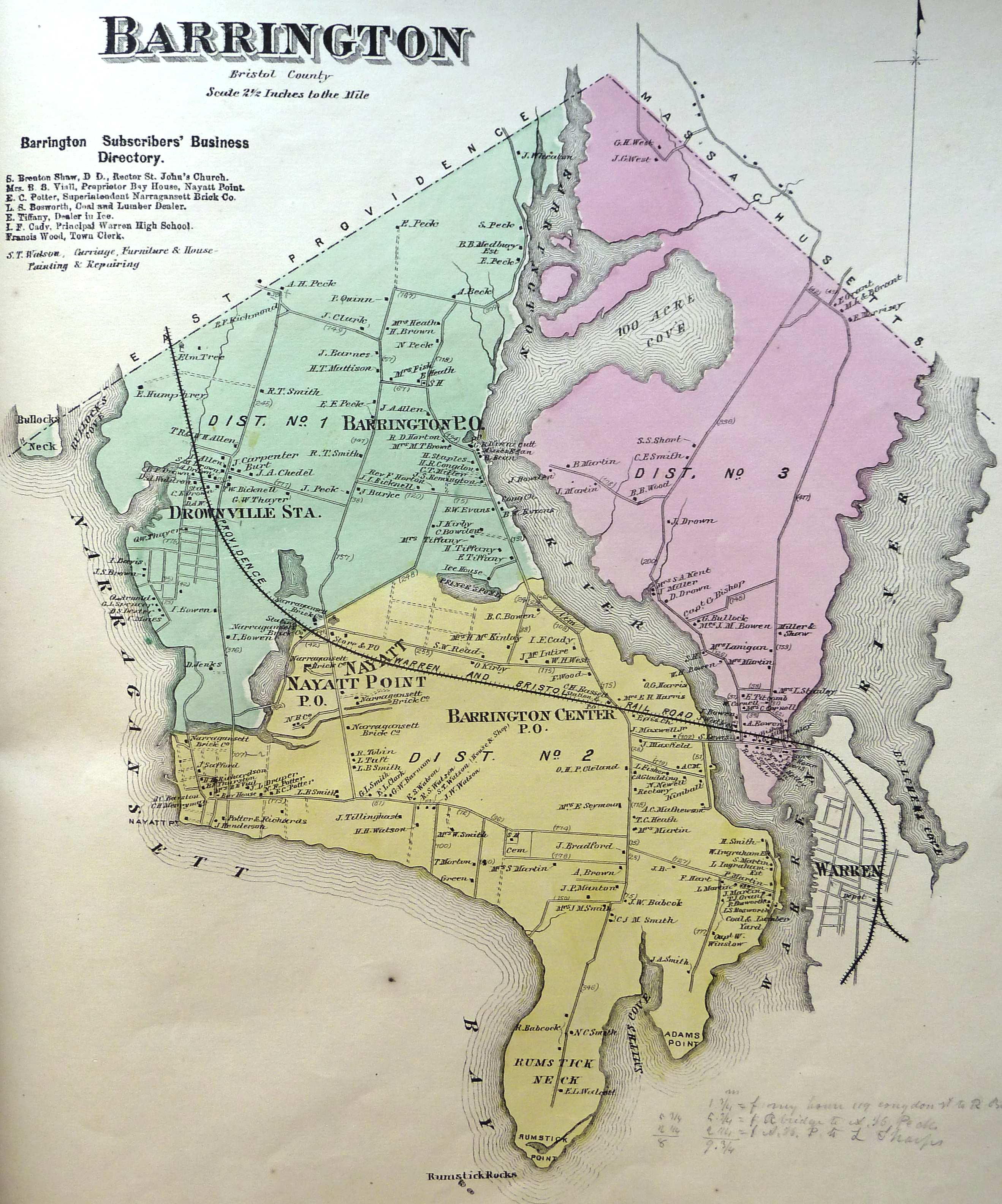
As a contrast, here’s the 1870 Beer’s Atlas map (again, click for hi-res):
Prudence Island: our Allins came to Barrington from there before 1680; and the story goes that in the winter of 1682, Narragansett Bay froze solid enough for William1 Allin to haul his house over it (presumably minus the stone-end chimney), a few miles up the bay from Prudence to Annawomscutt in West Barrington. Now it’s a ferry ride, ten minutes out from Bristol harbor and fifty years back in time. We spent a gorgeous daytrip there Saturday, biking around to beaches (on dirt roads, with kids in trailers), which wore us all out. But not before visiting the historical cemetery there. Actually, I only brought the 2-year-old to the graves: the others were enjoying one last swim.
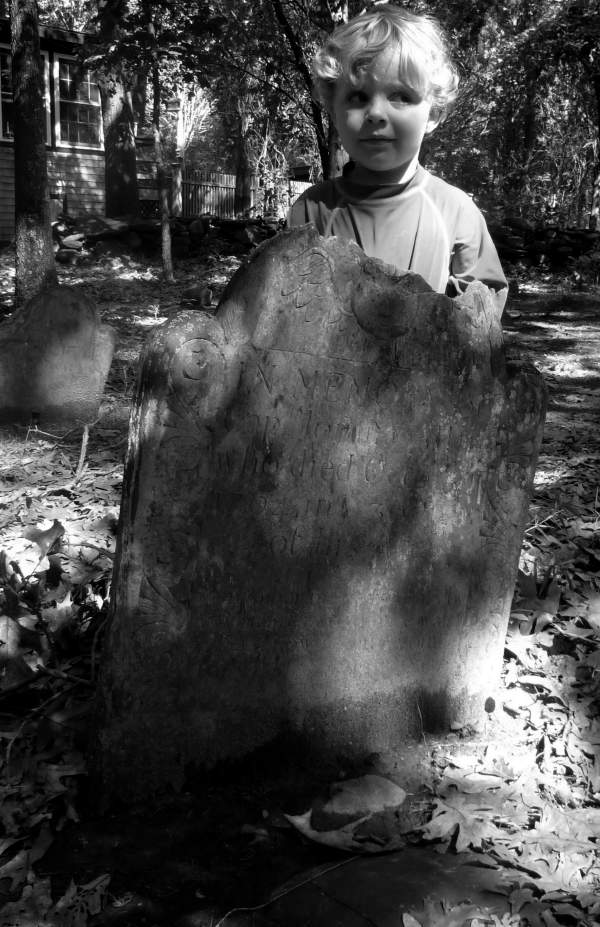
The graveyard lies up in the woods, blocks from the shore, long overgrown by pines but neatly kept beneath them. A couple dozen slate stones, still neatly matched head and footstones. Many of them small, though, not having had (or no longer showing) any formal carving. Two modern granite stones, and one table-tomb built up of flat fieldstones, but with the inscribed top stone (presumably slate) long gone. Of the few full-sized formal carved slate stones, Allins were readily visible. The first we found was Captain Joshua4 Allin, d. 1764 (John3, William2-1), a second cousin of our General Thomas. Here is Simon with Capt. Joshua:
Of the words on his stone, his forename is the hardest to read. (Continued)
One update after last Wednesday’s talk. The night before, fleshing out a slide show, I went back up to the attic to look at the 1798 Federal direct property tax valuation page pasted on the partition wall under the eaves, and took a closeup of what I realize is Thomas Allin’s signature, since it is pretty clear that this valuation was filled out in his own hand:
Only then did I realize that it is not every day that one finds, in an eighteenth-century house, the builder’s signature pasted to a wall! This seemed to make an impression at the Preservation Society meeting.
A clinched nail, tip curled like a snail, caught in the low afternoon sunlight coming through the 18th-century window at the west end of the attic, last November.
I’ve hardly blogged at all since we moved in January. I’m finally going through and organizing hundreds of photos taken during the course of our renovations, while I’m preparing for an illustrated talk I’m doing on the Allin House for the Barrington Preservation Society this Wednesday, May 11 (at 7:30 pm in the town library auditorium, if you’re interested): “The General in his Labyrinth: Exploring and Restoring the General Thomas Allin House.”
So many of the photos have such great stories attached that I could talk for hours. Some, like this, are just beautiful in their own right.
Wednesday, April 13, 2011
I have been completely ground to a halt by the Liljenquist collection of Civil War portraits at the Library of Congress.
Seven hundred cased photographic portraits of Civil War soldiers and sailors and their families — most of them anonymous — were donated last fall by the Liljenquist family, specifically the two boys, Jason and Brandon Liljenquist, who amassed the collection only over the last few years. The donation was noticed and began to be put online in the winter, but notice has recirculated now with the actual sesquicentennial of the outbreak of the war. These cased photos still abound and at least the anonymous ones are not too expensive to collect. But together this series is a priceless window into a whole generation.
The only press stuff I’ve seen does not provide good links. Here are the important links:
First, a selected slide show.
Second, the whole collection in a lightbox browser.
Finally, a moving essay by Brandon Liljenquist about creating and donating the collection.
Thank you, Brandon and Jason!
Part of the long process of settling into any house seems to be the endless shifting of stuff in basements, attics and garages. This sunny weekend I extracted from the basement an enormous pile of old storm windows — full height wooden sashes, mostly two over two, the style of the ‘modern’ replacement windows which were put onto this house — on the street-facing windows only — around the time of the First World War, but which were mostly removed in 1952. No longer needed, these storms have been brought up as giveaways for our architect, Lombard, who keeps quite a cache of old stuff for re-use. Among them were some really old sashes which aren’t storm windows at all, but regular sashes left over from the original fenestration. Mortised & pegged, with wavy glass now coated with years of good basement grime.
(Continued)
Wednesday, February 9, 2011
As of Monday, two households of stuff have now been moved into the Allin House, leaving two tides of debris in the basement —
— the second tide so large that our troglodyte feline has actually become ceiling cat. Sure enough, she was watching me, last night, as I tried to make some sense of the jumble beneath her.
Wednesday, February 2, 2011
Well, we finally moved in — in a break between blizzards, and almost a year after first concocting the idea.
Happy Candlemas, from the Allin House!
Tuesday, December 28, 2010
Christmas Eve I heaved a toilet into the dumpster, reducing our backyard ‘pottio’ from two holes to one.
Yesterday’s blizzard put a hat on our hardy remainder:
Happy New Year, from the Allin House!
Saturday, November 27, 2010
The seventh and last of a meager set of exterior photos dating back to 1898.
Jump to the other photos: 1898 | mid 1930s | late 1930s | 1952 | c. 1980 | 1992 | 2010
I took this photo in April 2010. In contrast with previous photo, note the size of the holly and other ground plantings; the bluestone cap on the main chimney; the re-excavated brick front walk. And, yes, the color . . .