
Private Jack Allin
Freed from Slavery, 19 May 1777, to Enlist in
Capt. Thomas Cole’s Company, 1st Rhode Island Regiment.
Died of Disease at the Continental Army Cantonment
at Valley Forge, Pennsylvania,
18 May 1778
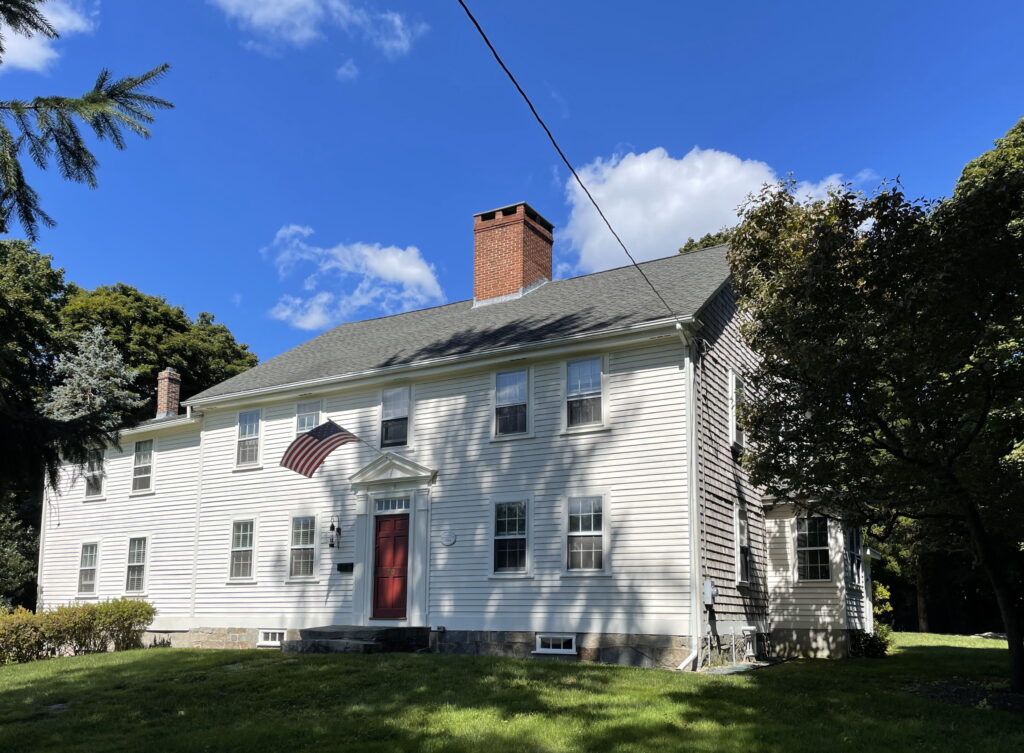
General Thomas Allin House, Barrington, Rhode Island
Nine years ago, in May 2017, while researching Civil War fatalities from Barrington, Rhode Island, in response to a Memorial Day request by Town Council present Mike Carroll, I learned that a young man who had lived in our Barrington house was killed in action in the Civil War: 2nd Lieutenant Joseph A. Chedel Jr., 1st Rhode Island Cavalry, killed at Middleburg, Virginia, 18 June 1863.[1]
This year, for America’s 250th, a similar request went out to research Barrington people who gave their lives in military service in the Revolutionary War. Working on this request, I learned that a second man from the same house lost his life on active military service. This man was a Revolutionary War casualty: Jack Allin of the 1st Rhode Island Regiment in the Continental Army.
Jack Allin was one of two men enslaved by the Allin Family who enlisted in the First Rhode Island Battalion (later called the First Rhode Island Regiment) in the Continental Army on May 19, 1777. Eight Barrington men enlisted that day to fill a town enlistment quota: a white officer (Ensign Simon Smith), a white sergeant, Enoch Jones, and six privates: a white man, Jonathan Andrews, a free Indigenous man, Joseph Sochorose, and four enslaved Black men, Jack Allin, Richard Allin, Thomas Reynolds, and Pomp Watson.[2]
Jack Allin and Richard Allin bore the surname of their enslavers, the prominent Allin family of West Barrington. As children, Jack and Richard had been slaves of Matthew Allin, who died in 1761, and are listed among nine enslaved people, only two of whom were adults, among the “Stock” — livestock — in Matthew Allin’s estate inventory, on 7 December 1761.[3]
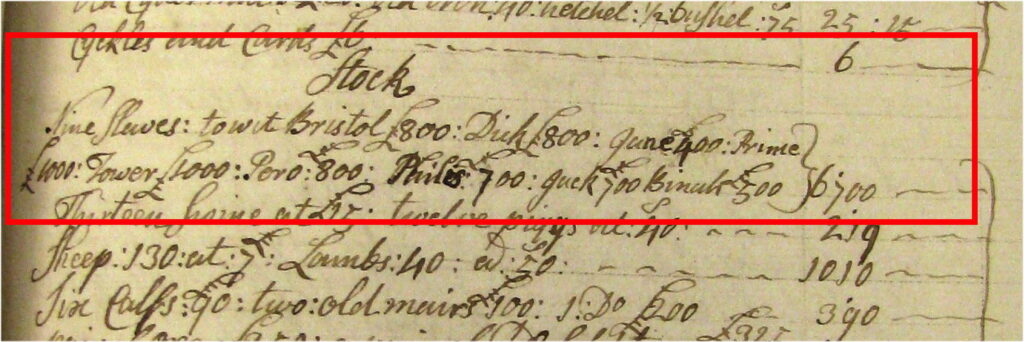
Jack, valued at £700, and Dick, valued at £800, in Matthew Allin’s estate inventory, 1761
Matthew’s two sons, Thomas and Matthew, divided up their father’s nine enslaved people along with the rest of the family estate. Records show that Richard was enslaved by Matthew Allin; Jack, therefore, was enslaved by Thomas Allin.[4] The Barrington men who joined the 1st Rhode Island Regiment on May 19, 1777, were all enlisted for a period of three years.
Jack and Richard served together in Capt. Thomas Cole’s company. The 1st Rhode Island left home in the summer of 1777, going first to New York and then to New Jersey, where they successfully engaged a superior force of Hessians at the battle of Red Bank (Fort Mercer), New Jersey, on October 22, 1777. In December, the 1st Rhode Island joined over twelve thousand Continental soldiers encamped with General Washington at Valley Forge, Pennsylvania.[5]
Jack Allin did not live to come home to Rhode Island. Reported as “sick,” but “present,” in Captain Cole’s company at the end of April 1778,[6] Jack Allin was then listed in May in a detachment mostly of sick men, five of whom died that month. The roll shows Jack Allin as “Deceased May 18, 1778.”[7]
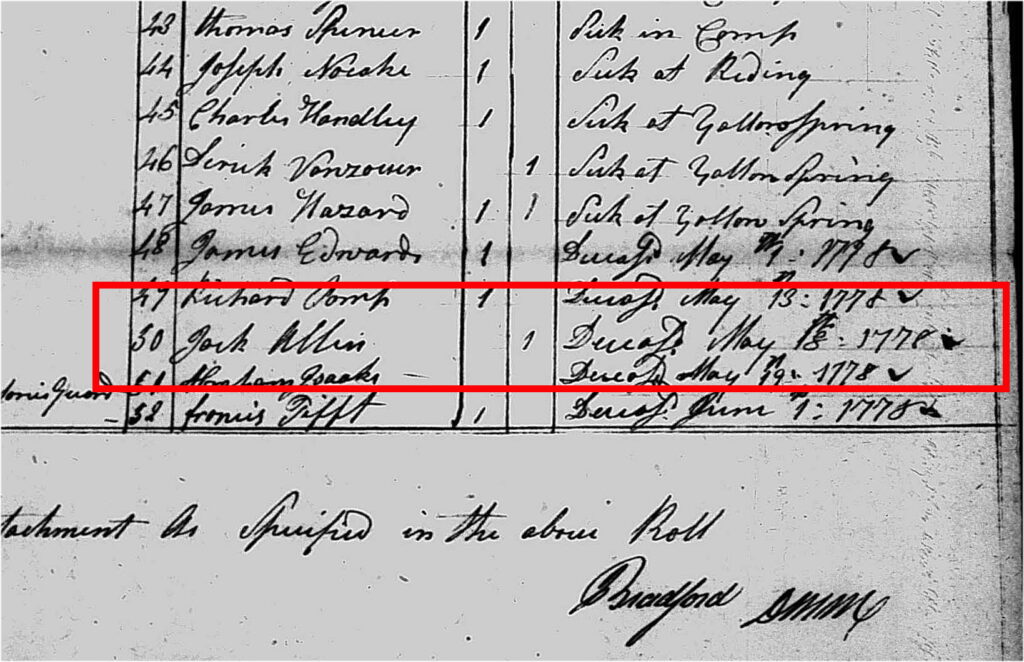
Jack Allin, deceased May 18th, 1778: Muster Roll entry
In his death, Jack Allin joined 1700 soldiers who lost their lives from disease, malnutrition, or exposure at Valley Forge in the harsh winter of 1777-1778. It is believed that most were buried in unmarked graves in different locations in the vicinity of the Valley Forge cantonment.[8]
After his death, Jack Allin’s story is closely intertwined, in the records, with that of his fellow-slave and fellow-soldier Richard Allin.
Richard Allin survived Valley Forge and the Battle of Rhode Island in August 1778, then served out his three-year enlistment until May 1780. He then went to sea on two privateer vessels out of Boston: the ship Tracey in July 1780 and the brigantine Adventure, where he was listed as “mulatto,” age 25, in the ship’s muster of 26 September 1780,[9] meaning that he had been about six years old when valued at £800 in Matthew Allin’s 1761 estate inventory.
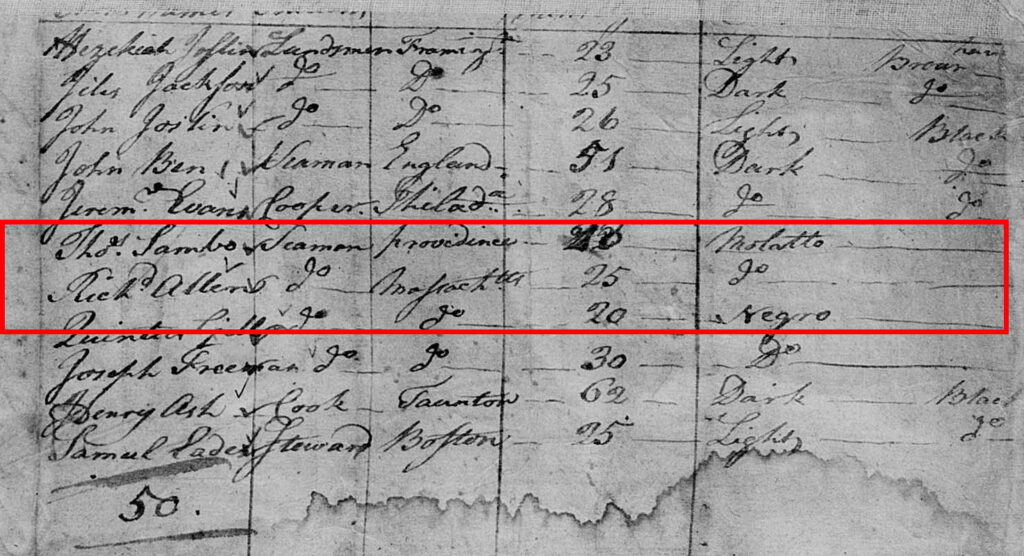
Richard Allin in Muster Roll of Brigantine Adventure, 26 September 1780
It is not known whether Richard was on active service on a privateer at the time of his death, but Richard was dead less than fourteen months after he is documented on the crew of Adventure. On 7 January 1782, Captain Thomas Allin was granted administration of the estates of “Jack Allin a free negro late of Barrington, deceased” and also of “Richard Allin a free negro man late of Barrington, deceased.”[10] Both Jack and Richard Allin were entitled to back pay from their service in the 1st Rhode Island Regiment. Richard, in addition, was owed prize money from his cruises on Tracey and Adventure. Jack Allin left no kin appearing in his estate records. Richard Allin, however, had married Patience Laurence, an Indigenous woman, who sought his remaining shares of the privateers’ earnings in a brief dated 26 February 1782.[11]
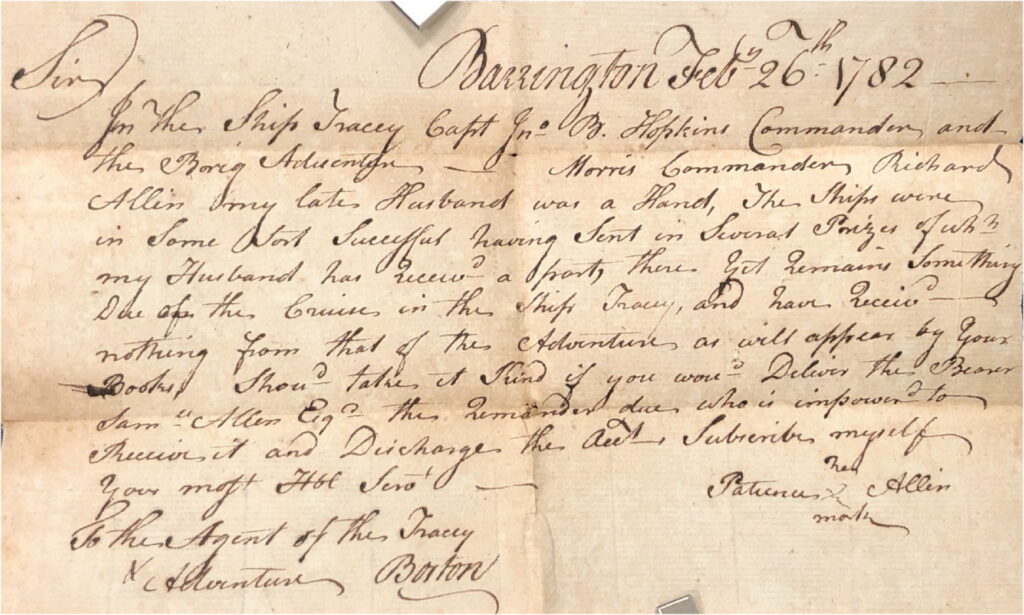
Richard Allin’s widow, Patience Allin, seeks his prize money from two privateer ships
Estate administration for Jack Allin and Richard Allin dragged on. The estate file does not mention Richard Allin’s prize money after 1782, let alone whether any of it was recovered by his widow, Patience. By March 1797, the estate of Jack and Richard consisted only of “certificates of depreciation” relating to unpaid wages in the 1st Rhode Island Regiment. Richard’s certificate of depreciation for £74 18s. 10d. was then valued at $150. A certificate of depreciation for Jack Allin’s back wages in the amount of £18 13s. 2d. had at some prior point “been fraudulently taken out of the general treasury by a person unknown”; any expectation of his wages was therefore valued at only $10.[12]
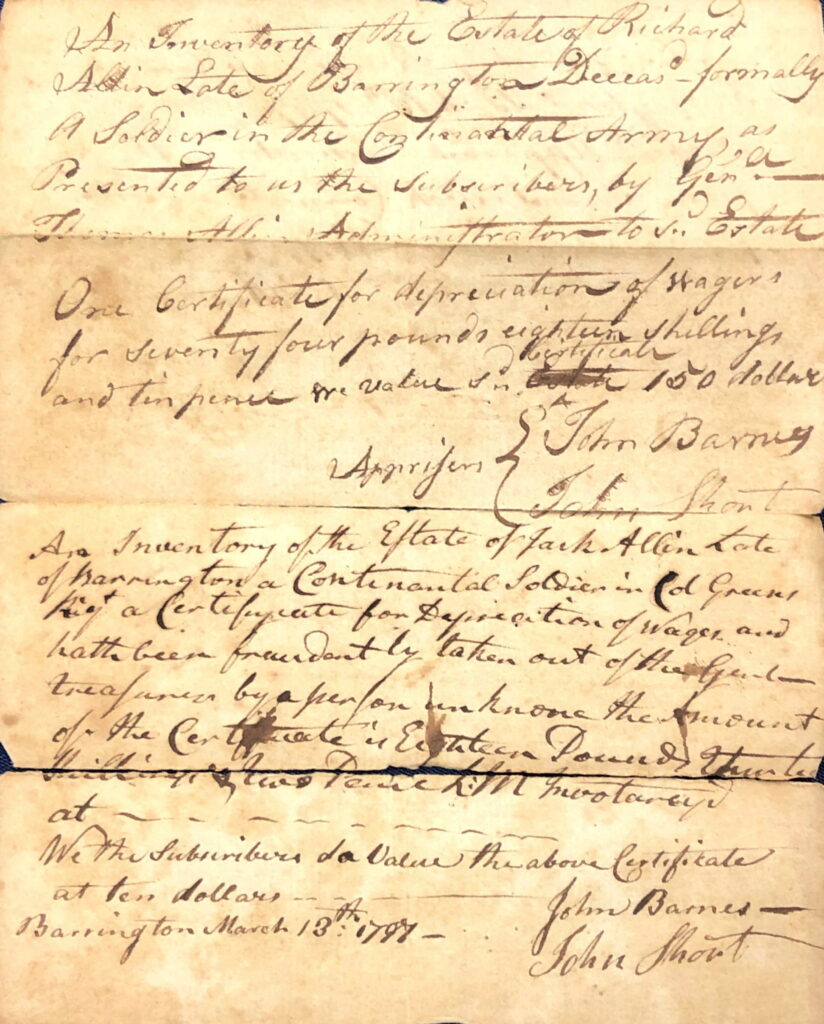
Valuations of back pay owed to Jack Allin and Richard Allin, 13 March 1797
Thomas Allin, Jack’s former enslaver and the administrator of Jack’s and Richard’s estates, was by then a general in the Rhode Island militia system. General Allin did not settle their estates before his own death in 1800; his widow, Amy, was called to account about it. Jack’s and Richard’s estates were finally closed on 4 February 1805, when town commissioners determined that all potential back wage claims had been exceeded by administrative costs of the case.[13] No kin of either man received a penny. This concluded a long postscript to what, in Jack’s case, had been only 364 days of military service.
A few years ago, while researching other Barrington houses for plaquing by Barrington Preservation Society, I conceived the idea of Gold Star Houses — whose occupants gave their lives in military service. It seems to me this is a thing worth remembering about people and their houses in our communities, just as Gold Star Families are and should be honored.[14]
Only now have I realized our Barrington house, the General Thomas Allin House, which is now on the National Register of Historic Places [15] and was built apparently between 1769 and 1774, is a double Gold Star House — through Lt. Joseph A. Chedel Jr. in 1863 and also, we now know, through Jack Allin in 1778.
Today is the 248th anniversary of Jack Allin’s death at Valley Forge.
[1] Nathaniel Taylor, “Joseph A. Chedel, Civil War casualty,” A Genealogist’s Sketchbook (blog), 29 May 2017.
https://nltaylor.net/sketchbook/archives/2212
Nathaniel Taylor, “Joseph A. Chedel Jr’s Gravestones,” A Genealogist’s Sketchbook (blog), 30 May 2017.
https://nltaylor.net/sketchbook/archives/2223
[2] Thomas W. Bicknell, History of Barrington, Rhode Island (Providence, 1898), 364-365, extracting from the first volume of Barrington Town Council records.
https://archive.org/details/historyofbarring00bick/page/364/mode/2up
[3] Warren, Rhode Island, Probate Act Book 2:236-237 (all of what is now Barrington, R.I., was part of Warren, R.I., from 1747 to 1770).
https://www.ancestry.com/imageviewer/collections/9079/images/007649150_00133 (FHC-locked).
That only two of the nine were adults is implied by Matthew’s will, dated 28 April 1761, in which he empowered his executrix (his wife, Ruth) to “sell any or either of my upgrown slaves if they be disobedient or of any ill behavior” (Warren, Rhode Island, Probate Act Book, 2:224-227). The inventory does not describe the color or ethnicity of the enslaved people, but Matthew’s will mentions that Ruth is to choose one female “negro” slave as her bequest. Richard (“Dick”) is described in one later document as “mulatto” (see below).
[4] Matthew and Thomas Allin each received a state bounty payment of £44 for Jack Allin and Richard Allin’s enlistment. The record of Richard Allin’s marriage, included in his estate file, states that Richard was “late a slave to Capt. Matthew Allin”; Jack, therefore, was enslaved by Thomas (Barrington, R.I. Estate File Papers, Old ser., no. 50 [not online]).
[5] Daniel M. Popek, They “Fought Bravely, But Were Unfortunate:” The True Story of Rhode Island’s “Black Regiment” (AuthorHouse, 2015).
https://books.google.com/books?id=HMnyCgAAQBAJ
[6] Muster Roll, Thomas Cole’s Co., 1st R.I. Regiment, Month of [April] 1778, “Revolutionary War rolls 1775-1783,” NARA Record Series M246, Roll 85: Rhode Island jackets (roll 1 of 4 for R.I.), FS DGS 004171621, Image 256/814.
https://www.familysearch.org/ark:/61903/3:1:3QSQ-G9WB-QW5N
[7] Muster Roll, “detachment” [Capt. Thomas Arnold], 1st R.I. Regiment, May 1778, “Revolutionary War rolls 1775-1783,” NARA Record Series M246, Roll 85: Rhode Island jackets (roll 1 of 4 for R.I.), FS DGS 004171621, Image 129/814.
https://www.familysearch.org/ark:/61903/3:1:3QS7-89WB-Q4KR
[8] Wayne Bodle, The Valley Forge Winter: Civilians and Soldiers in War (Penn State Univ. Press, 2002).
[9] “Muster rolls of the Revolutionary War, 1767-1833,” Massachusetts State Archives, SC1-57x, 75 vols., vol. 40 (Naval service, privateers), sheet 40, dorse (FamilySearch 8092199, Image 369/667).
https://www.familysearch.org/ark:/61903/3:1:3Q9M-CSJ7-C9NR-G
On this muster, he is listed as of “Massachusetts,” but the papers in his estate file leave no doubt this is the Barrington man.
[10] Barrington, R.I., “Probate and Council 1777–1818” [i.e., Town Council minute books, vol. 2], page 45.
https://www.ancestry.com/imageviewer/collections/9079/images/007649156_00075
[11] Barrington, R.I. Estate File Papers, Old ser., no. 50, estate of Jack Allin and Richard Allin: both the brief (pictured here) and a note with same date by Solomon Townsend, Town Clerk, attesting that Allin and Laurence had been lawfully married by him.
[12] Original note in Barrington Estate File Papers, Old ser., no. 50. Recorded in Barrington “Probate and Council 1777–1818” [i.e., Town Council minute books, vol. 2], p. 239.
https://www.ancestry.com/imageviewer/collections/9079/images/007649156_00177
[13] Barrington, Probate Acts “Book 3, 1798–1808” (i.e. vol. 1 of series independent of Town Council recs.), pp. 109-110 (not filmed by FamilySearch).
[14] Nathaniel Taylor, “Gold Star Houses,” A Genealogist’s Sketchbook (blog), 13 September 2023.
https://nltaylor.net/sketchbook/archives/1985
[15] Nathaniel Taylor, “Thomas Allin House on the National Register of Historic Places,” A Genealogist’s Sketchbook (blog), 13 September 2023.
https://nltaylor.net/sketchbook/archives/2246
Post a Comment